顯示具有 --Essays 標籤的文章。 顯示所有文章

2007年5月2日 星期三

Essays-1

What is Cyclical Space Painting?

Su Hsin-tien 31 December, 2006

I. About cyclical Space Painting


In Euclidean geometry, the shortest distance between two points is a straight line - the two points of which, if extended indefinitely, would never connect and would only grow further and further apart. However, in the real physical world, due to gravity an extended straight line could actually connect back with itself. For instance, on the earth's surface a straight line that moves ahead in the direction of the shortest distance would wrap around the globe and intersect on a point with itself. It could also turn like a vortex. An observer standing on the moon looking at a straight line on earth would actually see a round arc, the perimeter of which is called a "cyclical line."


Similarly, on a plane surface, lines radiating out in all directions would merely extend out into space indefinitely and would not intersect. However, as with the above example, on the surface of the earth, such lines continuously extended outward would blanket the entire earth's surface, forming a spherical plane. Earthbound people always feel like it's a plane, while someone on the moon would say it's a globe. This globe could be termed a "cyclical surface."


The problem with this is, is there such thing as a "cyclical body?" An orthographic cube formed with straight Euclidean lines consists of six surfaces. If each of the cube's surfaces were extended indefinitely straight out, expanding the cube infinitely, each straight line would be curved by gravity to link into a cyclical line, yet it would be difficult to draw this cube of cyclical lines. This is what has led me to my thinking on this concept, and based on readings between 1965 and 1970 I came to learn of the tremendous difficulty involved (See Illustration 1).

Illustration 1

蘇新田_img_2

If each edge of an Orthographic cube is extended in a cyclical line, together does it form a sphere? Judging by the perspective, object, picture plane, and eye point are the three critical factors determining graphic form (See Illustration 2).

Illustration 2: The three critical factors of perspective: object, picture plane, and eye point

蘇新田_img_3

As shown in Illustration 1, whether the eye point is fixed at point A, B, C, or D, it is located within the cyclical form. As it is inseparable from the cube, its complete form cannot be drawn unless the spherical glass is treated as a picture plane. This is illustrated by man's inability to render the earth as round unless viewed from a remote perspective far from the earth (See Illustration 3).

Illustration 3: Perspective of the Earth

蘇新田_img_4

By the same token, only when the human eye point goes outside the solar system can a perspective of the nine planets orbiting the sun be rendered ( See Illustration 4 ).

Illustration 4: Perspective of Solar System

蘇新田_img_5

Continuing, we can know that the Milky Way can only be rendered as a barred spiral galaxy from a perspective standing outside the Milky Way(See Illustration 5), rather than a vortex galaxy. (Liberty Times, 18 August 2005. Researchers at the University of Wisconsin revealed a comprehensive image of the Milky Way as a barred spiral. The barred spiral stretches 27,000 light years wide at both extremes.)

Illustration 5: Perspective of Milky Way

5

Nowadays, astronomers note that there are approximately 100 billion galaxies in the universe, each galaxy containing approximately 100 billion fixed stars. If this description approximates the truth, then humans could render a galaxy, two galaxies, three galaxies and so forth based on perspective... to form a perspective distance diagram. If that is the case, then could a human render 100 billion galaxies in one picture? The question is whether humans could attain a remote perspective from which to draw all 100 billion galaxies in the universe. If humans can draw the earth, solar system, and the Milky Way, then we could conceivably find a way to get far enough removed from the universe to render these 100 billion galaxies. But how would one attain such a remote perspective outside the universe? (See Illustration 6)

Illustration 6: Finite and yet Unbounded Universe, the artist cannot completely draw the Entire Universe

蘇新田_img_7

In this picture, due to the weight of the universe, straight lines in the universe do not continue ahead as with Euclidean geometry, so the relative physical positions of the planets in the universe may not be consistent with the Euclidean geometric relationships human thinking is based upon (how do Cartesian coordinates change?) (Encyclopedia Americana, V.12, pp.498-499, "Geometry: 6 Non-Euclidean Geometry Relevance to Real Space and Space-Time")


In 1905 Albert Einstein (1879-1955) proposed his narrowly defined theory of relativity, followed by the broadly defined theory of relativity in 1916. The Riemann geometric interpretation of the curved spaced of the universe proposed in 1917 notes that the universe is a finite sphere without boundaries. This thinking is in line with that of Chinese Warring States period astronomer Hui Shi, who said, vastness without limit is the great unity, smallness without interior is the minor unity. However, by the time of China's six great astronomers in the Jin dynasty, no view describing the universe as a finite cyclical universe was extant. The issue being, in relation to the three critical factors of object, picture, and eye point composing perspective, is it possible for humans to stand outside the above-illustrated universal space to render the entire universe? The answer is that it is impossible, because since the universe is a finite sphere without boundaries it has no exterior, so it follows that there is no place for the painter to stand beyond the universe from which to render its likeness.


One can conceivably render one Solar System, the Milky Way, five galaxies, 35,000 galaxies, up to 99.9 billion galaxies (N-1), but just by adding the final galaxy would there be no place for the artist to stand? Is that the case?


Under the theory of relativity dynamics universal view, by the 1930s astrophysicists had verified that the universe is in a state of expansion. Observers standing at any point in the universe can see stars all around, and that the relatively closer galaxies recede slower, while relatively distant ones recede faster. (Encyclopedia Americana, Astronomy Universe) For a rendering of curved space in accordance with the universal view, see the following illustration (See Illustration 7).

Illustration 7:
Spatial structure where various gravity fields in the universe exert influence on one another. This illustration is merely a partial special picture and cannot be extended to form a cyclical one (it cannot only form a sphere).(Su Hsin-tien, CYCLIC SPACE: Su Hsin-Tien's Multi-Dimensional World in Painting, 1998, p.39 upper picture)

蘇新田_img_8

The vertical lines of a cube on the earth in relation to the ground plane necessarily extend vertically towards the center of the earth, but where in outer space do the ones pointing in the opposite direction come together? (See Illustration 8)

Illustration 8 Moon Earth

蘇新田_img_9

Universal space formed by Cartesian coordinates (See Illustration 9) is an illustration of the Orthographic Coordinate System.

Illustration 9 Ptolemy system The Newtonian celestial sphere infinite space transcends the celestial sphere The viewer is located within the glass sphere

9

If a person stands inside the glass sphere and draws straight lines outside its surface, unfolding the glass into a plane, the resulting image would resemble Illustration 10. Straight lines on the surface of the glass are curved lines in the unfolded illustration below. Thus it follows that a sphere composed of Cartesian coordinates, at the planetary distance of astronomical observation, must be fixed again in perspective. (Su Hsin-tien, CYCLICAL SPACE: Su Hsin-Tien's Multi- Dimensional World in Painting, 1998, pp. 34-35)

Illustration 10

蘇新田_img_14

The ancient Greeks believed that fixed stars lined up on a celestial sphere. Aristotle (384-322 BC) posited that the celestial sphere consisted of 55 "crystal ball" layers, one inside the other. Hippachus (C. 190-120 BC), drew meridian lines on the celestial sphere. Ptolemy (AD100?-165/70?) proposed further standardizations (See Illustration11). (Pan-Chinese Encyclopedia; World Book: Astronomy)

Illustration 11

蘇新田_img_19

The celestial sphere concept remained in use through the twentieth century, and photographic techniques were employed to fix anew meridian lines and poles. However, in the early twenty-first century, advancements in satellite observation enable us to measure the distance of more fixed stars, while computers can establish the distance between different fixed stars or galaxies and people can read related information via computer. However, although the proximity of various fixed stars can be expressed, celestial sphere meridians are still relied upon to plot locations. If the distance of the farthest star could be ascertained, would that star be "the end of the universe?" If so, then the universe would be caught in the finite vs. infinite controversy, so would it be possible to render a "finite, boundless universe?" (See Illustration12)

Illustration 12:

An ancient Greek man penetrated the celestial sphere with a cane, but asked what the outside of the outside was? If the viewer in the picture seeks to express the stars mapped out on the celestial sphere with a planar three-di-mensional perspective, he must specify whether the picture plane (glass) is flat or round.

蘇新田_img_20

This gives rise to two problems: 1. The phenomenology of perspective in the threedimensional geometric space between the fixed stars and galaxies of the universe; 2. Is there an outline for the entire universe? Or do different galaxies circulate and envelop one another? What does that picture look like?


As for the first question, that depends on the method of perspective (Addressed in CYCLICAL SPACE, 1998. pp. 23-42), as illustrated by the following four graphics (See Illustrations 13-16).

Illustration 13: Classical triangulated perspective Horizon Line

蘇新田_img_24

Illustration 14: If curved lines in place of straight receding lines are employed for triangular cones above and below the horizon line, the below picture results. Horizon Line

蘇新田_img_25

Illustration 15 : Upper illustration is analysis; lower is perspective

蘇新田_img_26


The cylinder perspective was first employed by Maurits Cornelis Escher (18981972) in 1947. This perspective revealed that straight lines parallel to the horizontal plane remain straight lines.


The spherical perspective has been described earlier in this essay (as in Illustration 10). In both approaches, due to the curvature of the glass picture plane, unfolded on a flat plane they become receding curved lines. Meanwhile, curved space is described by the theory of relativity as the tangible curvature of physical phenomena. These different approaches compel me to seek another method, explained in Part III of this essay.


As for the second issue above, I have practiced "cyclical space painting" since 1970; that is, experimenting with an approach in many areas, with "objects without exteriors," "multiple objects enveloping one another," "spaces in which insides connect with the outsides," "universes empty on the inside," and "landscapes with multiple horizons, where each horizon line represents a gravitational realm." Examples are illustrated in the following pictures(Illustrations 16-19). A rubber ball, with "trees" growing perpendicular to the inner surface (See Illustration 16 ).

Illustration 16: Imagine the inside of the ball can be turned to become the exterior.
Illustration 17: In a state of chaos, the ball's interior and exterior are swapped.


蘇新田_img_27


Illustration 18: The ball's interior has been
Illustration 19: A rubber ball is rotated into turned around so that the trees extend a sort of Klein Bottle, with no distinction outward. between inside and outside.

蘇新田_img_28


II. Motivations and Objectives of Cyclical Space Painting


What I described in part I is the combined discussion about heavenly body phenomenon and perspective, and it has been the difficulty on spatial logic in my mind for a long time. Because of this, I tried various ways on painting and had a long-term accumulation, that's why I named all my artwork as "Cyclical Space Painting".


In CYCLICAL SPACE, a catalogue of my paintings published (in Chinese) in 1998, I outlined and discussed systematically the general theoretical suppositions and critical elements of cyclical space painting, with particular attention to the possible phenomena of perspective. This essay simply endeavors to go over these key points once again for the sake of "content analysis and categorical delineation" in the following section.


Cyclical Space painting is the expression of the knowledge and hypotheses described above using the forms and methods of painting. Simply put, it would be impossible to complete a circuit of three-dimensional space and cubes within the realm of Euclidean geometry. To wit, I have not seen such an explicable and satisfactory picture. Accordingly, I have tried to "approximate" the above-detailed objectives using optical illusions and distorted spatial perspectives. I have put forth my creative motivation with several linguistic devices in the form of questions, as follow:

* Can the circulation of three-dimensional cubes be felt through optical illusions and make the inside of an object continue to existence?
* Can using warped perspective give rise to objects and empty space that enclose each other? What's more, it is not empty infinite existence,
* The total area of all the planets and objects in the time and space of the universe must not be enveloped by the vacuous space outside in order for there to be a cyclical universe, but what does it look like?
* What is the effect of the warping of three-dimensional objects due to the gravitational force of the universe?
* What are the possibilities of illusionary paintings and distorted objects?
* What is the significance of multiple horizon painting?
* What are the possibilities of warped horizons and cyclical horizons?


It is with these questions in mind that I proceed with my art.

Illustration 20: Three Intersectional Horizon Lines, 2006

蘇新田_img_29


Essays-2

Essays-2

III. Cyclical Space Painting Analysis and Categorization


My works can be grouped together into categories according to the following six periods:

1. Initial experimentation (1969-71) Solo exhibition at the Oshkosh Public Museum in Oshkosh, Wisconsin, USA. This exhibition has not been grouped into an independent theme.

2. Horizontal Shift Illusions (1972-79) Solo exhibition in 1973 at the Taiwan Museum of Art (renamed National Taiwan Museum of Fine Arts), titled "Unbelievable Space." Works have been collected together thematically.

3. Non-objects (1980-84) All of the works enlisted for multiple exhibitions in the years following the 1983 opening of the Taipei Fine Arts Museum were oil paintings above Number 200.

4. Deep Illusions (1985-91) No solo exhibitions featuring works from this period.

5. Multi-dimensional Worlds (1990s to present) No solo exhibitions featuring works from this period were held at the time. The painting catalogue CYCLICAL SPACE was published in 1998. Finally, in 2004 selected works from this period were featured in a solo exhibition at the NAN Gallery's new Renai Gallery.

6. Cyclical Horizons (2004-06) Both "Distorted Objects" and "Rotating Spaces" were pursued during this period. Selected works were shown in a solo exhibition at the NAN Gallery's new Renai Gallery.


In the following section, analysis and categorization of artistic form and content is presented for the works dating from each of these periods.


Although chronological ordering makes for neat arrangement, old factors constantly prod at my mind. Old concepts also emerge during different periods. For instance, "Alternating Substance and Emptiness" and "Deep Illusions" constantly got in the way of my thinking at different times. Consequently, in analyzing my paintings it is necessary to look for various basic elements at play in various subjects.


In order to find possible cyclical images in spatial forms, analysis is conducted using assorted perspectives and logical hypotheses, and illusion is employed to strengthen imaginary variation. Amongst various interrelated factors, works can be roughly grouped into the seven following categories:
1. Alternating Substance and Emptiness
2. Spatial Displacement
3. Deep Illusion
4. Multi-dimensional World
5. Distorted Objects
6. Rotating Spaces
7. Cyclical Horizons


The above seven categories are grouped by appearance. Although similar to categories according to time period, and they can be expressed in a particular tie, they are probably arranged with a particular subject of exploration in mind. Perhaps illustrating them with simple pictures would serve to elucidate these distinctions further.


1. Alternating Substance and Emptiness


Matter exists in the three states of solid, liquid and gas [Josiah Willard Gibbs (18391903) proposed his Phase Rule in 1870], with the colloidal state found between solid and liquid. After undergoing physical or chemical changes, matter can be transformed into different states, such as ice melted into water, water heated into steam, or candle wax burned to form gas from solid.


As the classic Chinese treatise n philosophy the Dao De Jing states, the myriad things of the universe are "born out of nothing." Modern philosopher Guo Xiang comments, "something out of nothing, nothing out of something -unbelievable!" In my painting pursuits, in order to transform the interior of an object into the exterior, I employ the "two-sided method" on both sides of an outline, so that the front of the outline is a solid object while the rear is empty. This gives rise to an image of alternating substance and emptiness (See illustrations 21-24).

Illustrations 21: Shading is employed to a closed line to make each end solid, leaving the middle vacuous. This technique is employed in the following illustrations.

蘇新田_img_30

Illustration 22: No Exterior, No Interior, 1973

09其大無外其小無內No Exterior, No Interior

Illustration 23: When Substance Links with Emptiness, 1972

蘇新田_img_32
Illustration 24: You in Me, 1972


A picture that is an optical illusion often has some parts that cannot be closed up. And what is the positional relationship between a picture that does not look like an object and the background? This is the problem that has arisen when I render non-object painting. For instance, it is difficult to discern a coherent object or room composed by the space made by the picture's lines; normally, the outer borders of an object must be closed in order for it to take on form (See Illustrations 25, 26).

Illustration 25: The Space persented in this illustration is hard to translate into the real world

蘇新田_img_34

Illustration 26: World of Non-Objects, 1984

蘇新田_img_35


2. Spatial Displacement


Perspective expresses a three-dimensional world in two dimensions. In the real world, layer upon layer of objects is visible on the same position. If that object is transparent like glass, multiple layers of objects can be seen in front of and behind it, but due to the reflection of light on the glass, the object's outlines are difficult to discern. In order to alleviate this difficulty, I paint multi-level objects at the same position, using perspective trickery for heightened impact. The aim of spatial displacement is to explore what effects on perception are generated by the confused fore-aft relationships of objects. See the following illustration for elucidation of this aspect (See Illustrations 27, 28)
Illustration 27: Space Within Space, 1993
蘇新田_img_36

Illustration 28: Layers Within Layers, 2006

蘇新田_img_37

3. Deep Illusions


Can the optical illusion method be helpful on realizing the objective of "cyclical space?" This is what I'm interested in investigating. Optical illusion painting involves using shifting eye point movement and organization of image perception in the brain to produce the feeling that something is not quite right. In order to achieve just the right impact of illusion it is necessary to maintain appropriate distance between the movements of the visual focal points (see illustration 29).
Illustration 29: Pulling the top and bottom of a three-dimensional object too far apart on a horizontal plane has no discernible effect, while bringing them too close fails to produce an illusion.

蘇新田_img_38

There is a definite mathematical logic to three-dimensional objects in perspective. As in the illustration 30, if optical illusion is introduced to receding horizontal lines for each three-dimensional object, can it result in horizontal illusions? This is what I seek to explore in Deep Illusion. When both sides of a three-dimensional object are relatively close together when producing graphic illusions, it is difficult to achieve a composition manifesting such deep illusion (See Illustrations 31-34).

Illustration 30

蘇新田_img_39

Illustration 31: Life and Death Battle of Substance and Vacuity, 1987

22空間虛實的決鬥 Life and Death Battle of Substance and Vacuity

Illustration 32: Billowing and Flowing of Space at Dusk, 2006

蘇新田_img_41

Illustration 33: Summer Dusk, Heaven and Earth Switch Places, 1989

17天近地遠夏日黃昏 Summer Dusk, Heaven and Earth Switch Places

Illustration 34: Strong Gravitational Field Sucks Away Weak Landscape, 1989

16強重力場吸走了弱風景Strong Gravitational Field Sucks Away Weak Landscape


4. Multi-dimensional World


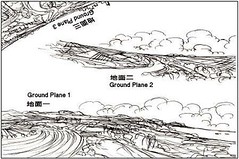
As described by the theory of relative dynamics, gravity causes bending of space in the universe. What new possibilities does this concept give rise to in relation to perspective? This is what Multi-dimensional worlds sets out to explore. What is the significance of the appearance of two or more horizon lines in one picture? Following is an analysis using sketches (See Illustrations 35-42). When the horizon line becomes a round curved form it resembles the view through a fish-eye camera lens. However, using today's photographic techniques and 3D computer graphics to link the two worlds of a landscape formed with two or more horizon lines together would require prodigious effort.


A curved horizon line on the one hand results in a wide-angle effect, while also representing spatial curvature and gravitational reordering. If the above scene were painted on a sphere and extended to a certain degree it could envelop the entire sphere. The same effect would be impossible with classical perspective.

Illustration 35: How does one handle the two overlapping horizon lines below?
Horizon Line B Ground Plane 2 Horizon Line A Ground Plane1

蘇新田_img_44

Illustration 36: What happens when one of the horizon lines is tilted? Horizon Line A Horizon Line B Ground Plane 2 Ground Plane1 Ground Plane1 Ground Plane2

蘇新田_img_45


Illustration 37: How does one handle gravity acting in opposite directions on the upper and lower horizon lines? [Note]: If the edges of a three-dimensional object are perpendicular to the horizontal plane, gravity is perpendicular to the horizon line. What happens when both the edges and the horizon line bend? Ground Plane 3 Ground Plane 2 Ground Plane 1
蘇新田_img_46


Illustration 38: What does it mean when there are three, four, five, or more horizon lines on a picture? How does one handle the meeting of different ground planes? What happens when objects that recede on different horizon lines approach one another? Should curved lines be used for vertical lines and receding lines perpendicular to different horizon lines? These issues have been discussed in my publication, CYCLICAL SPACE: Su Hsin-Tien's Multi-Dimensional World in Painting, 2004, in the section on pages 9-11 entitled Cyclical Space : Solo Exhibition Lecture.


Illustration 39: Universe Moved, Spring Arrives, 1999

27乾坤動後春來了Universe Moved, Spring Arrives

Illustration 40: Camping, Goats, Sunset and Sea Breeze, 1992

28野營、羊群、斜陽、海風Camping, Goats, Sunset and Sea Breeze

41: If a scene using classical perspective is formed into a cylindrical shape as with the above picture, in order to wrap it up into a ball the vertical lines perpendicular to the horizon lines must converge at one point.

蘇新田_img_49

Illustration 42: In multi-dimensional worlds, many horizon lines can curve. Any of the receding lines on them can be placed on a sphere, and land and sky can be arranged to wrap around each other appropriately.

蘇新田_img_50


5. Distorted Objects


If objects can be distorted at random and space can be curved, what new possibilities arise for the relationships between the "inside and outside" of space? When a three-dimensional object is seen as a suspension and can be distorted, it can take on a different form. In addition, techniques of illusion can be used to make one side of an object into an empty face (alternating substance and emptiness), which can then be distorted, or to distort the ground plane and thereby distort objects placed on it, or to produce distortion with confused gravity placement. I view all of the above as "object distortion" (See Illustrations 43-45).

Illustration 43: Interior with Rotated Gravity, 2004

41重力迴旋的室內Interior with Rotated Gravity

Illustration 44: House Inside-Out, 2006

蘇新田_img_52

Illustration45: Gravity Reordered, 2004

36重力重構Gravity Reordered


6. Spatial Rotation


What possibilities can come about through the new special forms fashioned by curving space? Using the "gravitational direction created by horizon lines," "exaggerated three-dimensional perspective," "object distortion," or "illusion" to create "two or more horizon line worlds" appears to allow interconnection into one world. Perhaps this device is similar to deep illusion, multi-dimensional worlds, or object distortion, but where it differs is in extending geometric wall shapes beyond the distant horizon. This is an unprecedented approach (See Illustrations 46-49).

Illustration 46: Green Summer, 2004

42青色的夏日Green Summer

Illustration 47: Landscape with Distorted Emptiness, 2004

43虛空扭轉後的風景 Landscape with Distorted Emptiness

Illustration 48: Look Out! Don't Get Sucked Into the Black Hole, 2006

39小心!不要被捲入黑洞Look Out! Don’t Get Sucked Into the Black Hole

Illustration 49: Around the World, 2006

40環繞十方世界Around the World


7. Cyclical Horizons

Cyclical horizon lines are curved lines and can be divided into two types:
(1) Curved and closed horizon lines; (2) Curved yet unclosed horizon lines.


Curving the horizon line(s) of a picture only makes either a circle or a vortex, as shown below (See Illustrations 50,51). Expanding these prototypical graphics can bring about numerous curved horizons representing variations of gravitational turns, like viewing the earth from outer space. This can give rise to many different ideas for various pictures and objects. When applied with spatial distortion and illusion, the linkage of different worlds can be treated (See Illustrations 52-55).


The above descriptions depict appearances. Now let's go back to the beginning to make a summary. My motivation for exploring the subject of "Cyclical Space" can be simplified into two fundamental objectives:


(1) How to create pictures of cyclical space? In particular, how to express this through perspective?


(2) Given the spatial curvature of the universe described since the acceptance of the theory of relativity, how can perspective be used to imagine such a world? Following is a simplified pictographic illustration of these concepts(See Illustration 56). For further information on what I am doing, other than taking paintings on their own terms this simple chart can provide a detailed picture.

Illustration 50: Circle Illustration 51: Vortex

蘇新田_img_58


Illustration 52: When the Horizon is Circled, 2001

44當水平線圍成圓圈時When the Horizon is Circled


Illustration 53: Three Realms Entwined, 2006

蘇新田_img_60


Illustrations 54: Double Heaven and Earth, 2006

51雙層天地Double Heaven and Earth


Illustration 55: Concave Cycle, 2006

45內曲面循環Concave Cycle


Illustration 56: Simplified Diagram of Cyclical Painting Su Hsin-tien 2006

Cyclical Space Painting Subjects What is finite and boundless spatial form? What is curved space in perspective technique? Emptiness isn't larger than the substance? Interior and exterior entwined? Assorted perspectives and conceptions of curved space. Painting Approaches Alternating Substance and Emptiness Spatial Displacement Deep IllusionMulti-dimensional Worlds Distorted Objects Rotating Spaces Cyclical Horizons

蘇新田_img_63


IV. Reflections on 40 Years as an Artist


Whenever I place my paintbrush down I often feel like I'm tumbling in space, unsure of the meaning and worth of my travails, and even less certain of how others feel about my works. Looking back over the past 40 years I now appreciate that, over the long process from initial curiosity about the universe to settling on painting subjects, and finally referring to my approach as "Cyclical Painting," I have been driven more by my thirst for the truth than pure artistic expression. That is to say, when it comes to art versus science I am an admirer of science's steady advancement. I greatly admire an artist who can move closer with every step to what he set out to achieve, yet my works are not scientific treatise - because they are packed full of dramatic human notions.


From youth and vigor to old age and infirmity, having endured shifts in the winds and the test of time filled with many comings and goings, I've been aided by elder mentors, relatives, friends and students who have helped me to steadfastly pursue my thematic approach, of which if there had never been any tangible accomplishments I would not feel the need to express any thanks. Finally, humanities scientists believe that human progress goes beyond human genetics and heredity to encompass the transmission of cultural genetics. With this in mind,


I personally believe that in the final analysis any work of art or any style, whether modern or post-modern, must retain elements of individual creativity. In this sense, even appropriation qualifies as a new approach. So now all I can do is offer my works up for the world to judge as it sees fit and determine what exactly I'm doing with my art.


When I was young my mind was sharp, I reacted quickly, and easily took decisive action. Now, the older I get the more constrained I have become by ordered thinking. At the same time, my body has deteriorated and I do things slower. I proceed methodically, yet my work is in the end that of an older man, not comparable to the way it was when I was young and fighting to make my way in society.


By the time the computer era swept Taiwan in the 1990s I no longer had the time and adaptability to take part in it myself. With a whole stack of data awaiting processing with my human brainpower it was already too late for me to get up to speed on the technical skills, so I assigned most of those tasks to younger folks to handle. The 1960s seemed like a new era to me, and the same was true for the 1990s. Indeed, time flies and life is so fleeting! If life is not cyclical, what is the meaning of it all ? (Translator: David J. Toman)


Illustrations 57: Su Hsin-tien
Photographer: Que Yi-jian, 1998

蘇新田_img_64


Essays-1